Direct dialing, dispatchable location, and what Arkansas charges per line
Federal law rewrote what office phone systems owe 911 callers, and Arkansas sets what every line pays for the service. Both layers - the obligations and the surcharge - are on this page with official sources.
Arkansas sets the 911 surcharge on Forrest City business phone lines at $1.30/connection/mo flat statewide fee for wireless + VoIP + 'nontraditional' service (Act 660 of 2019 'Public Safety Fee'). Landline/wireline is a SEPARATE, locally-set charge -- each city/county governing authority sets a uniform percentage (up to 85% of the tariff rate for basic exchange service) rather than one statewide landline number. - one of the few bill lines that is genuinely government-mandated, unlike the carrier-invented 'recovery' fees printed beside it.
Most phone contracts offered in Forrest City run 12-36 months with an automatic-renewal clause: miss the written-notice window, commonly 30-90 days before term end, and many contracts renew for another full term.
Forrest City plus 3 surrounding communities within 40 km hold about 26,041 people - enough business density for multiple providers and installers, which is exactly the competition a quote request should exploit.
The 911 line on your bill is one of the few that is genuinely government-mandated - your state sets it, and the rate varies enormously by state. What Arkansas charges, and what your phone system legally owes 911 callers, are both on this page.
Since 2020, federal law has required office phone systems to let anyone dial 911 directly - no dialing 9 first - and to send the caller's street address plus floor or suite to dispatchers automatically. Kari's Law is named for a woman whose daughter could not reach 911 from a hotel room phone.


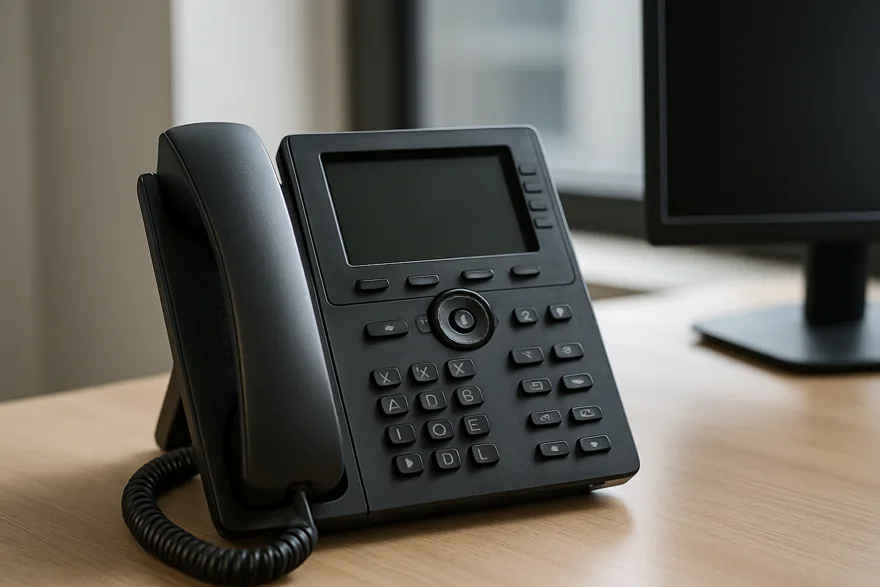

The 2026 numbers
| Phone system category | 2026 published range | The number that actually matters |
|---|---|---|
| Cloud VoIP seat (entry tier) | $15-$30/user/month | Annual billing runs 20-50% cheaper than monthly for the same tier |
| Cloud VoIP seat (mid tier) | $25-$50/user/month | Compare the all-in total with taxes and fees - commonly 20-30% on top |
| Contract term | 12-36 months typical (up to 84) | Miss the 30-90 day notice window and many contracts renew a full term |
| Taxes and fees on the bill | commonly 20-30% of the total | Federal USF (38.8% of interstate charges, Q3 2026) and state 911 fees are government-set; 'recovery' fees are carrier-invented |
| SIP trunking (keep your PBX) | $15-$30/channel/month | Priced per concurrent call, not per user - fits businesses keeping a PBX |
| Desk phones and wiring | $55-$280/phone; $125-$400/cabling drop | 'No upfront cost' plans still need handsets, drops and a PoE switch |
| Legacy analog lines (elevator, fire alarm, fax) | $30-$60/line/month cellular adapter | Copper holdout pricing runs $150-$500+/line - and standard VoIP fails those inspections |
Put a 911 compliance check out to competing bid before talking price
Two free marketplace paths: one form brings back multiple vetted providers who know they are competing for the job. Competing quotes are the only pricing discipline this industry consistently respects.
External links go to the marketplaces' own sites and forms. This site may earn a referral fee at no cost to you - it never changes the data above, and no individual provider pays to appear in our research.
What your phone system legally owes 911 callers
- Direct 911 dialing with no prefix - nobody should dial 9 for an outside line first (Kari's Law, effective February 2020)
- An internal notification - front desk or security - whenever 911 is dialed from the system
- A dispatchable location sent automatically: street address plus floor, suite or room (RAY BAUM'S Act Section 506)
- Coverage for new and existing multi-line systems alike - existing systems' deadline passed in August 2020
- Compliance guides commonly cite five-figure penalties; the obligations themselves come straight from the FCC's order
What Arkansas adds to a phone bill
| Question | Arkansas answer |
|---|---|
| State 911 surcharge (business lines) | $1.30/connection/mo flat statewide fee for wireless + VoIP + 'nontraditional' service (Act 660 of 2019 'Public Safety Fee'). Landline/wireline is a SEPARATE, locally-set charge -- each city/county governing authority sets a uniform percentage (up to 85% of the tariff rate for basic exchange service) rather than one statewide landline number. (mixed -- flat statewide per-connection fee for wireless/VoIP; percent-of-tariff, locally-set fee for wireline) - This is a genuine two-track system, not a data gap. |
| How the state treats VoIP providers | Arkansas PSC exercises minimal/no rate regulation over VoIP -- treated as an 'unregulated technology' under the state's Telecommunications Regulatory Reform Act of 2013, even while being pulled into the state's 911-fee net - Ark. Code Sec. 23-17-401 et seq. lets 'electing' incumbent carriers operate under competitive market forces rather than APSC rate regulation; APSC's own materials note. |
Arkansas runs two different 911 funding systems side-by-side in 2026: a modern flat $1.30 statewide fee for cell/VoIP, but an old-school, locally-set percent-of-landline-tariff fee (up to 85% of the tariff) for copper phone lines -- it never fully retired its pre-VoIP funding model when it modernized the mobile side.
This page is independent research, not legal, tax or purchasing advice. Fee schedules, 911 surcharges and telecom rules are set by federal and state authorities and by individual contracts, and they change - verify current rates with your state and the full fee schedule with any provider before signing.

What this means in Forrest City
A phone quote is only as good as the bill under it: the seat price is negotiated once, but the fee lines and the renewal clause bill you every month for the life of the contract.
This page is independent research, not legal, tax or purchasing advice. Fee schedules, 911 surcharges and telecom rules are set by federal and state authorities and by individual contracts, and they change - verify current rates with your state and the full fee schedule with any provider before signing.
Common questions
Why do phone system quotes differ so much between vendors?
Because quotes price the buyer, not just the seats: tier packaging, contract length, hardware bundles and how informed you seem all move the number - and the fee schedule under the quote varies by provider. That is the structural argument for marketplace-style shopping: one request, several providers who know they are competing, and the spread between quotes becomes your negotiating room.
Should I choose cloud VoIP or an on-premise PBX?
For most businesses under about 50 seats, published comparisons consistently favor cloud on five-year total cost: on-premise PBX hardware runs roughly $500-$2,000 per user upfront plus 15-20% of hardware cost in annual maintenance, while cloud runs $15-$90 per user monthly with no capital outlay. On-premise approaches break-even mainly for large, stable deployments that keep hardware seven-plus years and already employ IT staff.
How long are business phone contracts?
Twelve to thirty-six months is standard, with some contracts stretching to 84 months - and longer terms usually trade for lower monthly rates or 'free' hardware. The clause that matters more than the term is the renewal: many contracts renew automatically unless you give written notice inside a 30-90 day window, and a missed window can mean another full term with the early-termination fee reset.
Is the 'Regulatory Recovery Fee' a government fee?
No. Despite the official-sounding name, regulatory recovery and administrative recovery fees are set by the carrier, changeable by the carrier, and kept by the carrier - no law requires them or fixes their amount. The genuinely mandated lines are the federal USF contribution and state-imposed charges like your state's 911 surcharge. Ask any provider to split its fee schedule into 'government-mandated' and 'company-set' columns - the honest ones will.
Why is my phone bill higher than the quoted price?
Because the quote is the seat price and the bill adds two kinds of extras: genuine government charges - the federal Universal Service Fund contribution (38.8% of interstate charges in Q3 2026) and your state's 911 surcharge - and carrier-invented lines like 'Regulatory Recovery Fee' or 'Administrative Fee', which the provider sets at its own discretion and keeps. Together, taxes and fees commonly add 20-30% to the bill.
Put a 911 compliance check out to competing bid before talking price
Two free marketplace paths: one form brings back multiple vetted providers who know they are competing for the job. Competing quotes are the only pricing discipline this industry consistently respects.
External links go to the marketplaces' own sites and forms. This site may earn a referral fee at no cost to you - it never changes the data above, and no individual provider pays to appear in our research.
Prices in nearby cities
Fort Smith · Fouke · Fountain Hill · Fountain Lake · Fourche · Franklin · Fredonia (Biscoe) · Friendship · Fulton · Garfield · Garland · Garner