Direct dialing, dispatchable location, and what Missouri charges per line
Federal law rewrote what office phone systems owe 911 callers, and Missouri sets what every line pays for the service. Both layers - the obligations and the surcharge - are on this page with official sources.
Missouri sets the 911 surcharge on Lexington business phone lines at up to $1.00/month per subscriber line, but only in counties that have adopted it - no statewide default fee - one of the few bill lines that is genuinely government-mandated, unlike the carrier-invented 'recovery' fees printed beside it.
Most phone contracts offered in Lexington run 12-36 months with an automatic-renewal clause: miss the written-notice window, commonly 30-90 days before term end, and many contracts renew for another full term.
Lexington plus 10 surrounding communities within 40 km hold about 127,715 people - enough business density for multiple providers and installers, which is exactly the competition a quote request should exploit.
The 911 line on your bill is one of the few that is genuinely government-mandated - your state sets it, and the rate varies enormously by state. What Missouri charges, and what your phone system legally owes 911 callers, are both on this page.
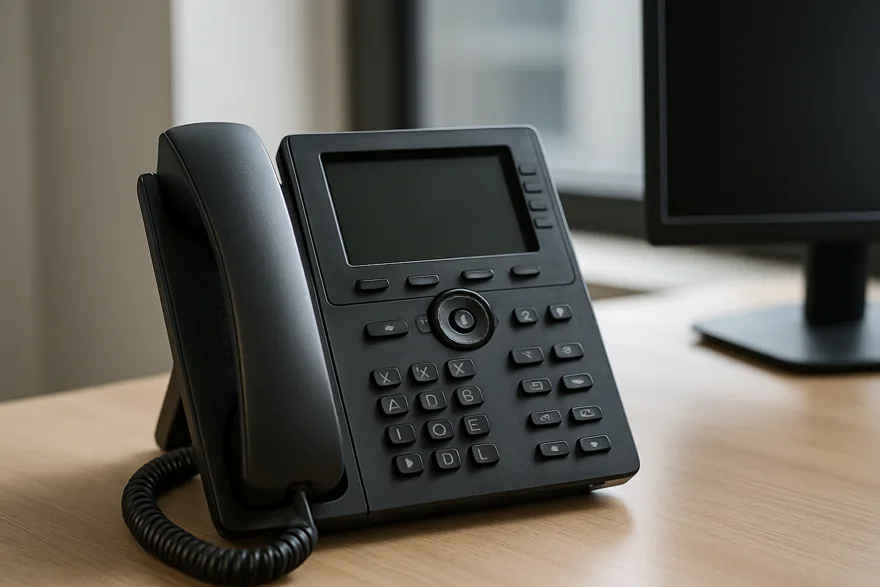
Since 2020, federal law has required office phone systems to let anyone dial 911 directly - no dialing 9 first - and to send the caller's street address plus floor or suite to dispatchers automatically. Kari's Law is named for a woman whose daughter could not reach 911 from a hotel room phone.



The 2026 numbers
| Phone system category | 2026 published range | The number that actually matters |
|---|---|---|
| Cloud VoIP seat (entry tier) | $15-$30/user/month | Annual billing runs 20-50% cheaper than monthly for the same tier |
| Cloud VoIP seat (mid tier) | $25-$50/user/month | Compare the all-in total with taxes and fees - commonly 20-30% on top |
| Contract term | 12-36 months typical (up to 84) | Miss the 30-90 day notice window and many contracts renew a full term |
| Taxes and fees on the bill | commonly 20-30% of the total | Federal USF (38.8% of interstate charges, Q3 2026) and state 911 fees are government-set; 'recovery' fees are carrier-invented |
| SIP trunking (keep your PBX) | $15-$30/channel/month | Priced per concurrent call, not per user - fits businesses keeping a PBX |
| Desk phones and wiring | $55-$280/phone; $125-$400/cabling drop | 'No upfront cost' plans still need handsets, drops and a PoE switch |
| Legacy analog lines (elevator, fire alarm, fax) | $30-$60/line/month cellular adapter | Copper holdout pricing runs $150-$500+/line - and standard VoIP fails those inspections |
Put a 911 compliance check out to competing bid before talking price
Two free marketplace paths: one form brings back multiple vetted providers who know they are competing for the job. Competing quotes are the only pricing discipline this industry consistently respects.
External links go to the marketplaces' own sites and forms. This site may earn a referral fee at no cost to you - it never changes the data above, and no individual provider pays to appear in our research.
What your phone system legally owes 911 callers
- Direct 911 dialing with no prefix - nobody should dial 9 for an outside line first (Kari's Law, effective February 2020)
- An internal notification - front desk or security - whenever 911 is dialed from the system
- A dispatchable location sent automatically: street address plus floor, suite or room (RAY BAUM'S Act Section 506)
- Coverage for new and existing multi-line systems alike - existing systems' deadline passed in August 2020
- Compliance guides commonly cite five-figure penalties; the obligations themselves come straight from the FCC's order
What Missouri adds to a phone bill
| Question | Missouri answer |
|---|---|
| State 911 surcharge (business lines) | up to $1.00/month per subscriber line, but only in counties that have adopted it - no statewide default fee (per subscriber of any 911-enabled communications service (landline, non-prepaid wireless, VoIP)) - RSMo Sec. 190.455 gives counties (not the state) the power to impose a monthly fee up to $1.00 on 911-enabled subscribers, but only after majority voter approval in that. |
| How the state treats VoIP providers | Interconnected VoIP (I-VoIP) providers are statutorily required to collect and remit the same fees as traditional local exchange carriers, without being generally rate-regulated as a public utility - RSMo Sec. 392.550 requires I-VoIP providers to charge and collect from end users, and remit, fees/surcharges 'in the same manner as' traditional local exchange telecom. |
Missouri is the only state in this batch with NO statewide 911 fee at all by default - it exists only where a county has put it to a public vote and won, meaning residents of non-adopting counties can legally pay $0/month in 911 surcharges on their phone bill while a neighboring county charges up to $1.00.
This page is independent research, not legal, tax or purchasing advice. Fee schedules, 911 surcharges and telecom rules are set by federal and state authorities and by individual contracts, and they change - verify current rates with your state and the full fee schedule with any provider before signing.

What this means in Lexington
What costs Lexington businesses the most is rarely the seat price - it is the 20-30% in taxes and fees stacked on top, and the contract terms that keep billing after the price negotiation is forgotten.
This page is independent research, not legal, tax or purchasing advice. Fee schedules, 911 surcharges and telecom rules are set by federal and state authorities and by individual contracts, and they change - verify current rates with your state and the full fee schedule with any provider before signing.
Common questions
How much does a business phone system cost per user?
In 2026 vendor list prices, entry tiers run about $15-$30 per user per month, mid tiers $25-$50, and top or enterprise tiers $50-$155 - with annual billing consistently 20-50% cheaper than month-to-month for the same tier. These are directional list-price ranges, not quotes: the real comparison adds taxes and fees, which commonly run another 20-30% of the bill.
Are the '99.999% uptime' claims real?
They are contractual targets, not audited history. The math: 99.999% allows 5.26 minutes of downtime a year, while 99.9% allows 8.76 hours - and independent status-tracking services document real incidents at every major provider. The practical risk is usually closer to home anyway: a local internet or power outage takes cloud phones down regardless of the provider's data centers, unless you configure cellular failover or call-forwarding in advance.
What is a typical early termination fee?
The most common structure is every remaining month multiplied by the monthly fee - a 24-month contract at $150 a month cancelled after 6 months can mean a $2,700 exit bill - though some providers use flat fees around $295-$995 instead. Providers may also claw back 'free' hardware or installation credits. No regulator caps these terms for business lines; the contract is the whole ballgame.
Can my phone provider stop me from keeping my number?
No. FCC rules bar any provider - including VoIP providers - from using a contract to block you from porting your number to another provider, and require simple ports, including to and from VoIP, to complete within one business day. An early-termination fee may still apply under your contract, but the number itself cannot be held hostage.
What is SIP trunking and when does it make sense?
SIP trunking replaces the copper lines feeding a phone system you already own - priced per concurrent call channel, commonly $15-$30 per channel monthly for unlimited plans - rather than per user. The decision line is your existing hardware: if you own a PBX worth keeping, SIP trunking preserves that investment; if you are ready to retire it, per-user cloud seats usually price out simpler and include the features separately billed elsewhere.
Put a 911 compliance check out to competing bid before talking price
Two free marketplace paths: one form brings back multiple vetted providers who know they are competing for the job. Competing quotes are the only pricing discipline this industry consistently respects.
External links go to the marketplaces' own sites and forms. This site may earn a referral fee at no cost to you - it never changes the data above, and no individual provider pays to appear in our research.
Prices in nearby cities
Liberal · Liberty · Licking · Lilbourn · Lincoln · Linn · Linn Creek · Linneus · Livonia · Loch Lloyd · Lock Springs · Lockwood