Direct dialing, dispatchable location, and what Montana charges per line
Federal law rewrote what office phone systems owe 911 callers, and Montana sets what every line pays for the service. Both layers - the obligations and the surcharge - are on this page with official sources.
Two free marketplace paths: one form brings back multiple vetted providers who know they are competing for the job.
Montana sets the 911 surcharge on White Sulphur Springs business phone lines at $1.00/access line/month - one of the few bill lines that is genuinely government-mandated, unlike the carrier-invented 'recovery' fees printed beside it.
Most phone contracts offered in White Sulphur Springs run 12-36 months with an automatic-renewal clause: miss the written-notice window, commonly 30-90 days before term end, and many contracts renew for another full term.
White Sulphur Springs, Montana has about 1,021 residents, and its phone-system market prices on contract terms, fee schedules and seat counts - the list price is the same everywhere; the total is not.
The 911 line on your bill is one of the few that is genuinely government-mandated - your state sets it, and the rate varies enormously by state. What Montana charges, and what your phone system legally owes 911 callers, are both on this page.
Since 2020, federal law has required office phone systems to let anyone dial 911 directly - no dialing 9 first - and to send the caller's street address plus floor or suite to dispatchers automatically. Kari's Law is named for a woman whose daughter could not reach 911 from a hotel room phone.


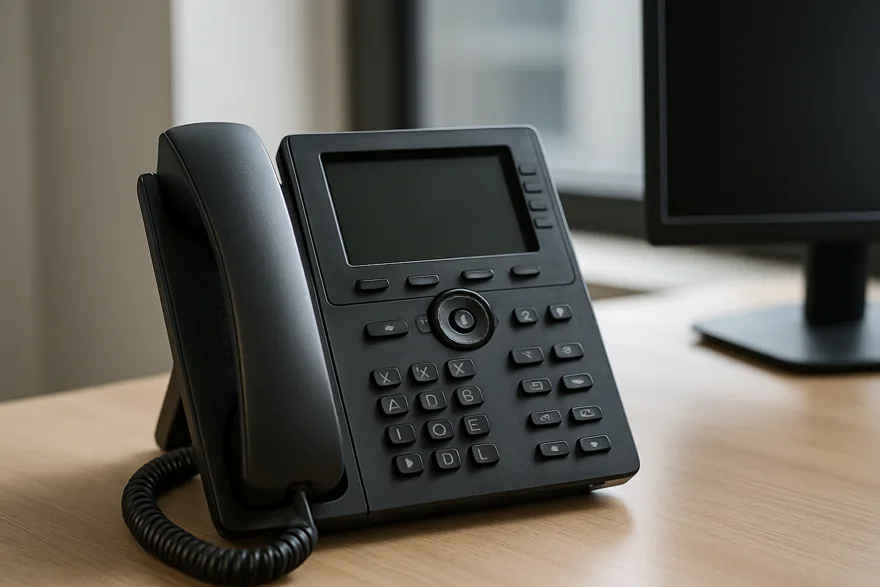

The 2026 numbers
| Phone system category | 2026 published range | The number that actually matters |
|---|---|---|
| Cloud VoIP seat (entry tier) | $15-$30/user/month | Annual billing runs 20-50% cheaper than monthly for the same tier |
| Cloud VoIP seat (mid tier) | $25-$50/user/month | Compare the all-in total with taxes and fees - commonly 20-30% on top |
| Contract term | 12-36 months typical (up to 84) | Miss the 30-90 day notice window and many contracts renew a full term |
| Taxes and fees on the bill | commonly 20-30% of the total | Federal USF (38.8% of interstate charges, Q3 2026) and state 911 fees are government-set; 'recovery' fees are carrier-invented |
| SIP trunking (keep your PBX) | $15-$30/channel/month | Priced per concurrent call, not per user - fits businesses keeping a PBX |
| Desk phones and wiring | $55-$280/phone; $125-$400/cabling drop | 'No upfront cost' plans still need handsets, drops and a PoE switch |
| Legacy analog lines (elevator, fire alarm, fax) | $30-$60/line/month cellular adapter | Copper holdout pricing runs $150-$500+/line - and standard VoIP fails those inspections |
Put a 911 compliance check out to competing bid before talking price
Two free marketplace paths: one form brings back multiple vetted providers who know they are competing for the job. Competing quotes are the only pricing discipline this industry consistently respects.
External links go to the marketplaces' own sites and forms. This site may earn a referral fee at no cost to you - it never changes the data above, and no individual provider pays to appear in our research.
What your phone system legally owes 911 callers
- Direct 911 dialing with no prefix - nobody should dial 9 for an outside line first (Kari's Law, effective February 2020)
- An internal notification - front desk or security - whenever 911 is dialed from the system
- A dispatchable location sent automatically: street address plus floor, suite or room (RAY BAUM'S Act Section 506)
- Coverage for new and existing multi-line systems alike - existing systems' deadline passed in August 2020
- Compliance guides commonly cite five-figure penalties; the obligations themselves come straight from the FCC's order
What Montana adds to a phone bill
| Question | Montana answer |
|---|---|
| State 911 surcharge (business lines) | $1.00/access line/month (per access line per service subscriber; statute explicitly extends 'access line' to include interconnected VoIP providers with activated 911 service) - Governed by MCA Title 10, Chapter 4 (10-4-101 definitions, 10-4-201 fee imposition). |
| How the state treats VoIP providers | All telecommunications providers (regulated or not, including VoIP by inclusion in the 911 fee statute's 'access line' definition) must register with the Montana PSC before offering service - Could not find a Montana-specific statute explicitly exempting VoIP from general PSC economic/rate regulation (unlike MD/MS/NE/NH, which have explicit carve-outs) - flag. |
Montana carries an active federal 'fee diversion' flag: the FCC's most recent (17th) Annual 911 Fee Report to Congress names Montana as one of only ~6 states/territories nationally (with NJ, NY, NV, RI, WV, USVI) that used collected 911 fees for non-911 purposes. Note: this diversion finding is sourced from a search-engine synthesis of the FCC report announcement, not a directly-parsed line from the primary FCC PDF table (www.fcc.gov blocked direct fetch with 403; recommend re-verifying against the primary FCC report if this fact needs to be load-bearing).
This page is independent research, not legal, tax or purchasing advice. Fee schedules, 911 surcharges and telecom rules are set by federal and state authorities and by individual contracts, and they change - verify current rates with your state and the full fee schedule with any provider before signing.

What this means in White Sulphur Springs
A phone quote is only as good as the bill under it: the seat price is negotiated once, but the fee lines and the renewal clause bill you every month for the life of the contract.
This page is independent research, not legal, tax or purchasing advice. Fee schedules, 911 surcharges and telecom rules are set by federal and state authorities and by individual contracts, and they change - verify current rates with your state and the full fee schedule with any provider before signing.
Common questions
Why is my phone bill higher than the quoted price?
Because the quote is the seat price and the bill adds two kinds of extras: genuine government charges - the federal Universal Service Fund contribution (38.8% of interstate charges in Q3 2026) and your state's 911 surcharge - and carrier-invented lines like 'Regulatory Recovery Fee' or 'Administrative Fee', which the provider sets at its own discretion and keeps. Together, taxes and fees commonly add 20-30% to the bill.
What hardware do I need for a VoIP system?
Desk phones run about $55-$90 entry-level, $120-$280 mid-range, and $400-$990+ for conference-room units in current reseller pricing. If your building lacks wired Ethernet at each desk, budget roughly $125-$400 per cabling drop installed, plus a PoE switch (from about $70-$150 for a basic 8-port unit) to power the phones. 'No upfront cost' plans price the software - the building's wiring is your line item.
Can my phone provider stop me from keeping my number?
No. FCC rules bar any provider - including VoIP providers - from using a contract to block you from porting your number to another provider, and require simple ports, including to and from VoIP, to complete within one business day. An early-termination fee may still apply under your contract, but the number itself cannot be held hostage.
How much does a business phone system cost per user?
In 2026 vendor list prices, entry tiers run about $15-$30 per user per month, mid tiers $25-$50, and top or enterprise tiers $50-$155 - with annual billing consistently 20-50% cheaper than month-to-month for the same tier. These are directional list-price ranges, not quotes: the real comparison adds taxes and fees, which commonly run another 20-30% of the bill.
What do Kari's Law and RAY BAUM's Act require?
Since 2020, multi-line phone systems - the kind offices, hotels and campuses use - must let anyone dial 911 directly with no prefix (no dialing 9 first), must notify a front desk or security office when a 911 call is placed, and must send a 'dispatchable location' - street address plus floor, suite or room - to emergency dispatchers automatically. Compliance guides commonly cite penalties reaching five figures; the substantive obligations come straight from the FCC's own order.
Put a 911 compliance check out to competing bid before talking price
Two free marketplace paths: one form brings back multiple vetted providers who know they are competing for the job. Competing quotes are the only pricing discipline this industry consistently respects.
External links go to the marketplaces' own sites and forms. This site may earn a referral fee at no cost to you - it never changes the data above, and no individual provider pays to appear in our research.